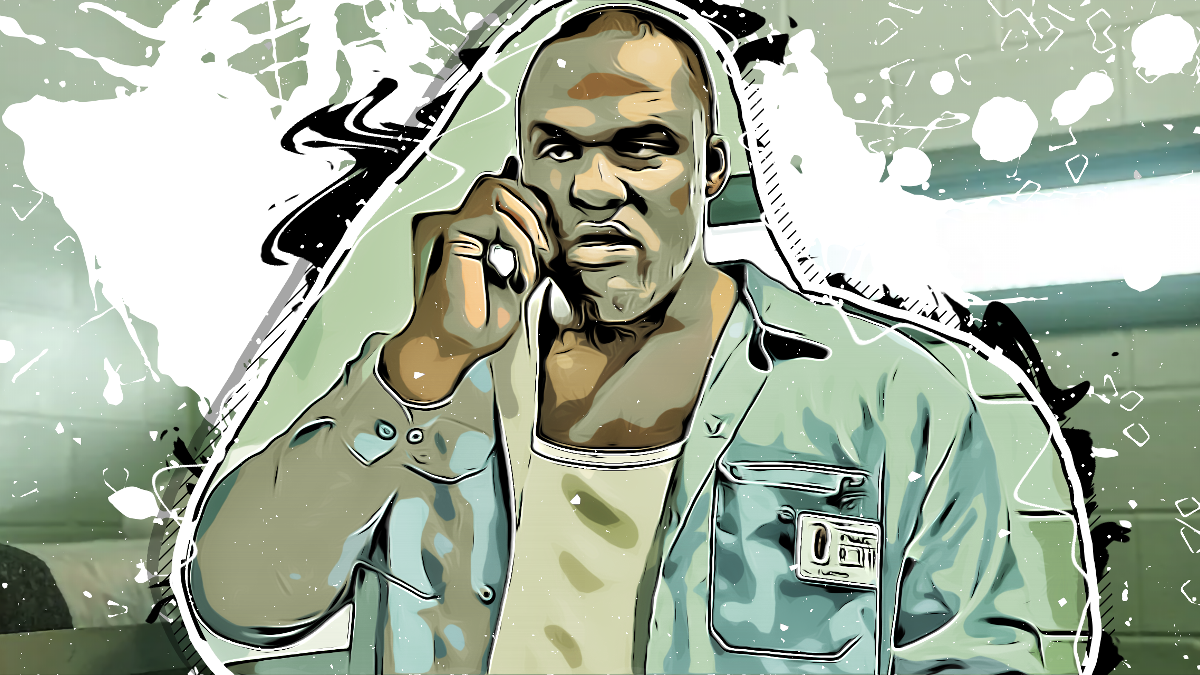
Ronald Glen “Big Baby” Davis appears on season 2 of Power Book IV: Force. In episode 5, “Crown Vic” Davis makes his debut as King Kilo, aka “D-Lo.” UPROXX explains that Kilo is locked up at the Southville Prison where Diamond was previously incarcerated.
Similar to Larry Hoover who ran the Gangster Disciples while he was locked up, Kilo is the leader of the RD gang and leads them from Southville Prison. RD ambushed Diamond while at a diner, but he knows Kilo didn’t call for the attack, so he wants to unite his CBI crew with KIlo’s RD gang. Diamond calls Kilo and tells him his plans and Kilo explains that he’ll accept the offer to establish a coalition, if he can get half of the profits CBI earns from selling drugs at Southville.
Diamond tells Tommy that Kilo wants half their business in the joint and Tommy takes the phone from Diamond and hangs up on Kilo. Later in the episode, Tommy changes his mind and tells Diamond that he wants to establish the coalition with Kilo.
The coalition seems loosely based on Larry Hoover’s Folk Nation, which he established in 1978, while incarcerated. Folk Nation is an alliance of several gangs in Chicago, including the Black Disciples and Gangster Disciples. The organization lended aid to any group, in Chicago, that struggled for survival. All gangs agreed to help each other with the protection of their neighborhoods and of their business interests.
Chicago Gang History explains that the first three public housing projects built in Chicago were the Jane Addams Homes, Julia C. Lathrop Homes and the Trumbull Park Homes.
By the 1960s, CHA was the largest landlord in Chicago, with more than 40,000 units of housing. These big numbers led to big problems. Housing projects like Cabrini-Green and the Robert Taylor Homes became concentrated areas of intense poverty and crime.
By the 1970s, Chicago’s street gangs dominated CHA’s high-rise developments, using them as recruitment centers, where they sold their drugs and tormented residents. The gangs turned the city’s projects into war zones, with a death rate so high that it was nicknamed Chiraq.
Curtis Mayfield, singer Polo G, rapper Eddie Johnson, NBA player Charlene Mitchell, presidential candidate Kim Foxx, Cook County State’s Attorney
The first part of the Cabrini-Green housing project, the Frances Cabrini Homes, was completed in 1942 and consisted of 55 two-story and three-story buildings on the Near North Side of Chicago. In 1958, an extension was constructed next to the project which was nicknamed the “reds” because of its red brick exterior. The reds consisted of 15 buildings which were each 7 stories, 10 stories or 19 stories tall.
In 1962, the William Green Homes were constructed. The buildings were known as the “whites” and contained 1,096 units in 8 white buildings that were each 15 or 16 stories tall. They were located north and west of the Cabrini Extension.
In the 1950s, the Egyptian Cobras gang formed and started to move into the project where they absorbed members of the Imperial Chaplains and Clovers. In the 1960s, the Black Deuces gang, also referred to as the Deuces Wild, moved into Cabrini where they battled the Egyptian Cobras for control of the project.
The Vice Lords arrived in the 1960s and by the 1970s, the Disciples and Egyptian Cobras began battling for control of Cabrini. The Black Deuces would eventually joined the Black Disciples. In 1978, all Disciples were converted into Black Gangster Disciples and Cabrini followed “Gangster” concepts and became BGD. Once the gang was established, a powerful drug ring formed in the project which helped the BGDs take over Cabrini.
The Gangster Disciples made millions in profits selling drugs in Cabrini-Green throughout the 1980s and 1990s. The Vice Lords and Mickey Cobras, also known as the Cobra Stones, controlled a few buildings but the GDs called the shots in a majority of the project. About 95% of the project was GD.
In 1989, a 19-year-old GD named Charles “Big Chuck” Dorsey led a group of GDs that decided to stop sharing their profits with the gang. They were earning easy money fast, and Chuck was convinced that they no longer needed to be Disciples and wanted to establish a new crew. They called themselves the Renegade Crazy Crew and broke ties with the Disciple Nation.
The move angered Disciple leaders and Cabrini-Green exploded with violence. The Renegade Crazy Crew went to war with the rest of the Disciples, with both sides using TEC-9 machine guns as their weapon of choice. The war terrorized residents for more than 2 years, before the Disciples decided to extend a peace offering to Big Chuck: A leadership position in the gang, in exchange for bringing his Renegade Crazy Crew back into the fold. The power struggle fractured the gang, leaving members with bitter feelings about Big Chuck and his crew.
The Renegade Crazy Crew’s disloyalty would be only the first blow to the gang’s stronghold on the projects. A few years later, on October 13, 1992, 7-year-old Dantrell Davis was holding his mother’s hand, walking the 100 foot distance, from his building to Jenner Elementary School. A sniper, located inside one of the gang controlled buildings, shot Dantrell in the head, killing the 7-year-old.
The suspect, Anthony Garrett, later told police that he shot Dantrell by mistake. Garrett explained that he was trying to shoot rival gang members but the 7-year-old got in the way. The incident led to a gang truce, that lasted for 3 years. Metal detectors were installed in the building and residents were issued ID cards. Police were at the project on a regular basis and gangs were no longer able to sell drugs freely. The murder gained national attention and played a significant role in the ultimate decision to demolish Cabrini-Green.
The ABLA Homes complex (also known as “the village” or “the vill”) was a CHA development comprised of four separate housing projects located on the near west side of Chicago. “ABLA” is an acronym for the names of the four housing projects:
Jane Addams Homes
Robert Brooks Homes
Loomis Courts
Grace Abbott Homes
Each project is discussed below.
In the 1940s, the Imperial Chaplains and 14th Street Clovers gangs controlled these projects.
Chicago Gang History explains that the Vice Lords street gang took over the project in the 1960s, after members migrated from the North Lawndale neighborhood. The Vice Lords forced the Chaplains and Clovers out the project but in the late 1960s, the Black Gangster Disciples moved into the projects and started beefing with the Vice Lords.
In the 1980s, the Black Gangster Disciples began referring to themselves as the Black Gangsters (BG’s) or “New Breeds” and they continued their war with the Conservative Vice Lords (CVL) and Traveling Vice Lords for control of these projects.
Jane Addams Homes
Location
University Village, Near West Side, Chicago, Illinois
Units
1,027
Groundbreaking
1938
Completed
1939
Demolished
2002
Notable Residents
N/A
The Jane Addams Homes were completed in 1939, making it Chicago’s first public housing project. The complex contained 1,027 units throughout 32 buildings.
The project was located in the University Village neighborhood on the Near West Side of Chicago. The Public Works Administration (PWA) and CHA implemented racial segregation at the development, and in January of 1938, only white families were selected as tenants for the Jane Addams Homes. The project was built for the poor Italian and Russian-Jewish population from the Near West Side during the Great Depression.
After pressure from local Black politicians, the CHA began inviting black families to the project, but they only lived in two buildings. By the 1950s, white families began to move out of the project and blacks began to move in.
Gangs took over from the 1960s to the 1980s. Crime and violence continued to increase throughout the 1990s, and by 2002, the Jane Addams projects were demolished.
Robert Brooks Homes
Location
University Village, Near West Side, Chicago, Illinois
Units
835
Groundbreaking
1942
Completed
1943
Demolished
1998-2001
Notable Residents
N/A
The Robert Brooks Homes were built in 1943 and contained 835 two-story row house units. The project was located in the University Village neighborhood on the near West Side, across the street from the Jane Addams projects. From 1997 to 2000, the complex was rebuilt in two phases.
Robert Brooks set a precedent for large projects and a strategy for expanding existing projects. As was the case in other Chicago public housing projects, gang activity and violence plagued the complex and demolition started in 1998. The last building was torn down in 2001.
Loomis Courts
Location
University Village, Near West Side, Chicago, Illinois
Units
126
Groundbreaking
1950
Completed
1951
Demolished
N/A
Notable Residents
N/A
The Loomis Courts project was located in the University Village neighborhood on the near West Side and was completed in 1951. The complex contained 126 units in two, seven-story buildings.
Loomis Courts was adjacent to the Robert Brooks Homes and was one of 8 complexes, all of which were called courts, built to house people displaced by the Chicago Housing Authority’s urban renewal projects. In 1951, Loomis was cited as one of the 10 best new publicly financed housing projects in America, by a committee of architects appointed by the national Association of Housing Officials.
“This partnership will secure substantial funds to improve aging public housing at ABLA Brooks and Loomis Courts and create long-term employment opportunities for CHA residents. It will serve as a catalyst for future growth on the Near West Side for years to come.”
In 2005, CHA started a two-phase rehabilitation process that preserved Loomis Courts as affordable rental housing. Unlike most the ABLA Homes, Loomis Courts was not demolished.
Grace Abbott Homes
Location
University Village, Near West Side, Chicago, Illinois
Units
1,198
Groundbreaking
1952
Completed
1955
Demolished
2005-2007
Notable Residents
N/A
The Grace Abbott Homes were located in the University Village neighborhood on the near West Side and was completed in 1955. The project contained 1,198 units throughout 40 buildings. Seven of the buildings were 15-stories tall and the rest of the units were two-story row houses.
On April 22, 1987, Ruthie Mae McCoy, was sadly murdered by someone who came into her apartment through her bathroom mirror. McCoy lived on the 11th floor of the Abbott Homes and called 911 to report that someone was trying to break in through her medicine cabinet. The call confused the dispatcher who didn’t note McCoy’s report as a break-in, instead it was recorded as a disturbance with a neighbor.
The misreport led to a lack of urgency on the part of the police officer sent to McCoy’s apartment and when they finally got there, they knocked and no one answered the door so they left. The next evening, McCoy’s neighbor called the police because they were worried about her whereabouts. Chicago Police returned and knocked McCoy’s apartment door again and after no one answered, they left.
McCoy’s neighbor decided to contact the management office and a carpenter was sent to the apartment to drill the lock on the door. Sadly, Ruthie Mae McCoy was found dead in her bedroom. She was shot multiple times and detectives learned that the killers entered her apartment, from the adjacent unit, by breaking in, through the bathroom’s medicine cabinet. The murder inspired the 1992 film Candyman.
a woman named ruthie mae mccoy was murdered in chicago in the 80s by someone who came into her apartment through her bathroom mirror, the candyman movie is allegedly loosely based on it. lawsuit!!! https://t.co/wPD9tLXzS0
In 2005, four of the high-rises were demolished, and the last buildings were torn down in 2007.
3. Ida B. Wells Homes
Location
Bronzeville, South Side, Chicago, Illinois
Units
1,662
Groundbreaking
1939
Completed
1941
Demolished
2000-2011
Notable Residents
N/A
The Ida B. Wells Homes, which also comprised the Clarence Darrow Homes and the Madden Park Homes, was a public housing project located in the Bronzeville neighborhood on the South Side of Chicago. The complex was completed in 1941 and was built exclusively for black tenants. Ida B. Wells contained 1,662 units of row houses, mid-rises and high-rises.
Throughout the 1940s and 1950s, the Deacons gang dominated the project. In the 1960s, the Black P. Stones and Black Disciples forced the Deacons out. The Stones and BDs continued to battle over control of Ida B. Wells, throughout the 1980s and 1990s.
Demolition of the project began in 2000 and the last building was torn down in 2011.
4. Clarence Darrow Homes
Location
Bronzeville, South Side, Chicago, Illinois
Units
480
Groundbreaking
1961
Completed
1961
Demolished
1998
Notable Residents
N/A
The Clarence Darrow Homes were located in the Bronzeville neighborhood on the South Side of Chicago, adjacent to the Ida B. Wells Homes. The complex was completed in 1961 and contained 480 units within four buildings, each 14 stories tall.
Active gangs in the Clarence Darrow Homes project included the Black P. Stones and Gangster Disciples. Sadly, in 1994, two boys dropped a five-year old named Eric Morse to his death from one of the Darrow buildings for refusing to steal candy for them.
The Clarence Darrow Homes were demolished in 1998. In 2003, construction of Oakwood Shores, a mixed-income community began on the former location of the Ida B. Wells, Madden Park and Clarence Darrow Homes.
5. Madden Park Homes
Location
Bronzeville, South Side, Chicago, Illinois
Units
279
Groundbreaking
1969
Completed
1970
Demolished
1999-2005
Notable Residents
N/A
The Madden Park Homes were completed in 1970 and contained 279 units in three nine-story buildings and seven buildings that were three-stories tall. The project was the last high-rise built by the Chicago Housing Authority and was located in the Oakland neighborhood on the South Side of Chicago.
The Black Gangster Disciples dominated the project in the 1970s. In the 1980s and 1990s, the Gangster Disciples and Black P. Stones beefed over control of Madden Park, leading to numerous murders. In the mid 1990s, a large fraction of the Gangster Disciples became Black Disciples, and a war between GDs and BDs erupted.
In 1999, demolition of the Madden Park Homes began and the last building was torn down in 2005.
6. Stateway Gardens
Location
Bronzeville, South Side, Chicago, Illinois
Units
1,644
Groundbreaking
1955
Completed
1958
Demolished
2000-2007
Notable Residents
Ronnie Lester, NBA player
Stateway Gardens was constructed in 1958 and contained 1,644 units, in two buildings that were ten stories tall and six buildings of 17 stories. It was located in the Bronzeville neighborhood and was part of the State Street Corridor which included the Robert Taylor Homes, Dearborn Homes, Harold Ickes Homes and Hilliard Homes.
A few years after it was constructed, Stateway was plagued by gang violence and organized crime. By the 1980s, most of the Del Vikings gang joined the BDs but some members of the Del Vikings united with the Black Gangster Disciples. The gangs fought for control of the Stateway Gardens leading to numerous murders.
In the 1990s, the Gangster Disciples and Black Disciples continued to beef for control of the buildings, intimidating hired security guards at the property. When gang members entered the complex, guards would look the other way. Several guards were attacked and even stabbed at the development.
The Stateway Gardens was one of the most dangerous projects in the nation and by the 2000s, the first set of residents were vacated and demolition began in 2001. By 2006, the last residents were vacated and in 2007 the last buildings were torn down.
7. Dearborn Homes
Location
Bronzeville, South Side, Chicago, Illinois
Units
800
Groundbreaking
1949
Completed
1950
Demolished
N/A
Notable Residents
N/A
The Dearborn Homes were located in the Bronzeville neighborhood on the South Side of Chicago and contained 800 units within 16 buildings, each six stories or nine stories tall. The complex was constructed in 1950 and was the first high-rise project completed by the Chicago Housing Authority.
In the 1960s, the Cobra Stones, formerly the Egyptian Cobras, currently the Mickey Cobras, controlled Dearborn. By the 1970s, Black Gangster Disciples were active and GDs eventually controlled multiple buildings on the north side of the project. The Mickey Cobras remained in control of most of the project, including all the southern buildings.
The courtyard between the buildings was often the sight of sniper shootouts between Cobras and GDs. The Mickey Cobras continued to dominate the project in the 2000s.
Michael Colyar, comedian Mr. T, wrestler Kirby Puckett, MLB player Corey Holcomb, comedian Ronnie Lester, NBA player Maurice Cheeks, NBA player
Construction of the Robert Taylor Homes began in 1960 and was completed in 1962. The complex was located in Bronzeville and contained 4,415 units throughout 28 high-rises, making it one of the largest public housing project in American history. Each building was 16 stories tall and they were identical, mostly located in U-shaped groups of three.
The Egyptian Cobras, also known as the Mickey Cobras, were one of the first gangs to claim Robert Taylor as their territory in the 1960s. The Del Vikings gang also moved into the project along with the Black Disciples.
In the late 1960s, the Egyptian Cobras became the Cobra Stones and started selling heroin in the project. By the 1970s the Devil’s Disciples, Del Vikings and Cobra Stones dominated Robert Taylor as drug dealing and gang violence increased in the project.
Throughout the 1980s and 1990s, the Mickey Cobras, Gangster Disciples and Black Disciples dominated the housing project and battled for control on a daily basis.
In the early 1990s, it was decided to replace Robert Taylor with. a mixed-income community. By 2006, the Chicago Housing Authority moved out all residents and in March of 2007, the last building was demolished.
9. Raymond Hilliard Center
Location
Near South Side, Chicago, Illinois
Units
1,077
Groundbreaking
1966
Completed
1966
Demolished
N/A
Notable Residents
N/A
The Raymond Hilliard Center is located on the northern end of the State Street Corridor on the near South Side of Chicago. The complex was constructed in 1966 and contained 1,077 units.
The project was designed by architect, Bertrand Goldberg who believed that other public housing projects were designed to punish tenants for being poor and did little other than warehouse them. Raymond Hilliard was built to be a structure which tenants would be proud to live in.
Residents were screened carefully and as a result, crime rates were lower at the property. It was the only CHA project never to require a uniformed police detail, but there was some gang activity. Throughout the 1980s and 1990s, the Gangster Disciples were active at Raymond Hilliard.
In 2002, renovations began, and lasted until 2006. The complex is now a mixed-income community called the Hilliard Towers Apartments.
10. Harold Ickes Homes
Location
Bronzeville, Near South Side, Chicago, Illinois
Units
738
Groundbreaking
1954
Completed
1955
Demolished
2009-2011
Notable Residents
N/A
The Harold Ickes Homes project was completed in 1955 and located in the Bronzeville neighborhood on the near South Side of Chicago. The complex contained 797 units in 8 buildings, five of which were seven stories tall and three that were nine stories.
The Gangster Disciples dominated the project for decades. From 1989 to 1996, security sweeps were conducted and if a resident didn’t have ID, they could be arrested. The security guards were removed in the late 1990s, leading several gangs to attack the GDs, in attempts to takeover control of the complex.
The GDs ruled for a substantial period of time so, there was not as much violence at the Ickes, compared to other projects. In the 2000s, rival gangs continued to try to force the GDs out the project, leading to numerous murders. Sadly, innocent residents were often caught in the crossfire.
Demolition of the Harold Ickes Homes began in 2009, and the last building was torn down in 2011.
11. Henry Horner Homes
Location
Near West Side, Chicago, Illinois
Units
920
Groundbreaking
1955
Completed
1957
Demolished
1995-2008
Notable Residents
N/A
The Henry Horner Homes were completed in 1957 and located in the Near West Side area of the city, adjacent to the Chicago Stadium. The complex contained 920 units in seven buildings that were each seven stories tall, and two buildings that were 15 stories tall. Henry Horner’s design was similar to the Harold Ickes Homes.
In the 1960s, the Egyptian Cobras, Imperial Chaplains and 14th Street Clovers were active in the project. The Vice Lords eventually rose to power, conquering the Clovers and forcing out the Cobras. In the late 1960s the Supreme Gangsters moved in from Englewood and began recruiting, leading to beef with the Vice Lords. The Supreme Gangsters ultimately became the Black Gangster Disciples, establishing GD presence at Henry Horner.
In the 1970s, the Blackstone Rangers dominated the project. By the 1980s, active gangs included the GDs, Four Corner Hustlers, Traveling Vice Lords and Gangster Stones. The Gangster Stones were founded at the project’s 150 Lake Street building, which they called “The Fortress.”
The project was featured in the 1995 movie, Losing Isaiah, starring Halle Berry. Demolition of the Henry Horner Homes began in 1995 and the last building was torn down in 2008.
12. Rockwell Gardens
Location
East Garfield Park, Near West Side, Chicago, Illinois
Units
1,126
Groundbreaking
1958
Completed
1959
Demolished
2003-2007
Notable Residents
N/A
Rockwell Gardens was constructed in 1959 and contained 1,126 units in 8 buildings, which was each 10 or 13 stories high. The complex was located in the East Garfield Park neighborhood on the Near West Side of Chicago.
30 years as a cop today. (2) departments but always loved the jets. Started in Ida B., worked Taylor, Abla, Horner, Ogden Courts, the Greens, but Rockwell was my favorite. Respect went both ways; policing is different today.
The first decade of the complex was decent but that changed after the assassination of Martin Luther King Jr. which led to riots in 1968 that destroyed most of the west side of Chicago. In the years that followed, gangs like the Vice Lords began to take over the development. The Renegade Vice Lords, Traveling Vice Lords, Conservative Vice Lords and Gangster Disciples began beefing over the heroin trade in the area, leading to several murders.
By the late 1980s, Rockwell Gardens was a part of Chicago’s “Operation Clean Sweep” which was a government and police initiative to eliminate gang activity and drug deals in the city’s housing projects. The New Life security team helped reduce crime at the property but once budget cuts were made, crime and violence reemerged.
Demolition began in 2000, and the last building was torn down in 2006.
13. Maplewood Courts
Location
Near West Side, Chicago, Illinois
Units
300
Groundbreaking
1961
Completed
1961
Demolished
2014
Notable Residents
N/A
The Maplewood Courts projects were constructed in 1961 and contained 300 units in two buildings, each seven stories tall. The complex was located on the near West Side and were essentially an extension of the Rockwell Gardens project.
The Four Corner Hustlers were active in the project and by the 1970s, gang and drug activity increased rapidly. Crime continued throughout the 1980s and 1990s, and in 2014, Maplewood Courts was demolished.
14. LeClaire Courts
Location
Garfield Ridge, South West Side, Chicago, Illinois
Units
314
Groundbreaking
1949
Completed
1950
Demolished
2009-2011
Notable Residents
N/A
LeClaire Courts was built in 1950 and located in the Garfield Ridge neighborhood on the South West Side of Chicago. The development initially contained 316 units of two story row houses. An extension was built in 1954 which consisted of another 300 units of row houses.
LeClaire Courts was one of the first integrated public housing projects in North America and were initially ideal for African Americans. The development wasn’t overcrowded like the high-rises located in Chicago’s inner city. However, the traditional troubles of public housing eventually took hold. In the 1960s, blacks started buying homes in the neighborhood as whites fled Garfield Ridge.
Several gangs were active in the project throughout the 1970s. White gangs like the Mad Lads and Insane Popes formed to fight black gangs including the Black Gents. In the 1980s, the Four Corner Hustlers were active along with the Black P. Stones and Vice Lords. All the gangs were part of the People alliance so initially, they operated in peace and didn’t feud. By the late 1980s the Black Gents joined the Black Gangster Disciples and gang activity rapidly increased at LeClaire.
After several decades of insufficient funding for maintenance, the buildings gradually deteriorated and in 2009, LeClaire residents were relocated to prepare for demolition and redevelopment. The last building was torn down in 2011 and in 2023, the housing authority authorized a new mixed-income residential development to be built where LeClaire Courts was previously located.
15. Racine Courts
Location
Washington Heights, Far South Side, Chicago, Illinois
Units
122
Groundbreaking
1949
Completed
1950
Demolished
N/A
Notable Residents
N/A
Racine Courts was completed in 1950 and located in the Washington Heights neighborhood on the far South Side. It contains 121 units of two-story row houses, making it one of the smallest projects built by the housing authority.
Racine Courts is located in a middle-class residential area and each unit has a full basement. They were built in 27 clusters, most located on Racine Avenue.
In the 1960s, residents were unhappy with the housing authorities mismanagement of the project and organized a group called Hometown to manage the property as a co-op. In 1969, Hometown assisted tenants in purchasing their own apartments at affordable rates while Hometown managed the property. Racine Courts has been a co-op ever since.
The Gangster Disciples and Black P. Stone gangs have been active throughout the project but have not been able to completely take over the complex thanks to an effective neighborhood watch program.
16. Trumbull Park Homes
Location
South Deering, Far South Side, Chicago, Illinois
Units
434
Groundbreaking
1938
Completed
1938
Demolished
N/A
Notable Residents
N/A
Trumbull Park Homes was built in 1938 and contained 434 units in 55 buildings. The complex is located in the South Deering neighborhood on the far South Side of Chicago.
Trumbull Park contained two-story row houses and four-story apartment buildings, similar to the Jane Addams Homes and was built to house poor white residents who were suffering due to the Great Depression and were interested in obtaining employment in the numerous industries on the far South Side of the city.
On July 30, 1953, the housing authority moved a black woman named Betty Howard, along with her family into the complex. Starting on August 5, 1953 and lasting for several months, white residents at the Trumbull Park Homes, tormented Howard, by throwing rocks and setting off fireworks and stink bombs at her unit. It was so bad that the Howards needed to be escorted everywhere by the Chicago Police.
In October of 1953, the housing authority moved 10 more black families into the project, leading to more violence and daily riots, which laster for more than seven months. CHA threatened to evict anyone that tormented the Howards and soon enough, several evictions took place due to residents who refused to comply.
In 1953, Black families moving into Trumbull Park housing project in Chicago ignited a painful and enduring riot, lasting over three years. More than a thousand policemen were deployed to maintain order during this turbulent period. The riot in Trumbull Park was sparked by racial… pic.twitter.com/Ver75TsbHU
In 1963, the housing authority mandated that blacks had the right to live in the complex but it remained mostly white until the 1970s when Wisconsin Steel began layoffs, leading to white flight in South Deering.
By the 1980s, the Trumbull Park Homes were majority Mexican and African American and gangs like the Gangster Disciples and Conservative Vice Lords began taking over. The Mexicans eventually established the Spanish Vice Lords and King Cobras, who also attempted to take over the development. In the 1990s, the Gangster Disciples and King Cobras joined forces against the Conservative Vice Lords and the Spanish Vice Lords but the Spanish Vice Lords and King Cobras were ultimately ran out of the project.
Although several gangs were active in the buildings, Trumbull Park was one of CHA’s safest projects. The property was renovated in the 2000s, and still stands today.
17. Altgeld Gardens Homes
Location
Riverdale, Far South Side, Chicago, Illinois
Units
1,498
Groundbreaking
1944
Completed
1945
Demolished
N/A
Notable Residents
N/A
The Altgeld Gardens Homes project was completed in 1945 and located in the Riverdale neighborhood on the South Side of Chicago. The complex contained 1,498 units, most of which were two-story row houses and was built for black veterans returning from World War II. In 1954, CHA built the neighboring Phillip Murray Homes which consisted of 500 more two-story row house units.
Altgeld Gardens was nicknamed Chicago’s “toxic donut” due to having the highest concentration of hazardous waste sites in the United States. There are 50 landfills and more than 300 industrial facilities near the project. Residents have been subject to contaminated drinking water and the community has some of the city’s highest rates of cancer.
Throughout the 1970s and 1980s, there were several active gangs in the development, including the Vice Lords, P. Stones, GDs and BDs.
The Wentworth Gardens projects were completed in 1947 and originally contained 422 units in low-rise buildings. The complex was located in Armour Square, a neighborhood on the South Side of Chicago and was originally built to house African American since the nearby Bridgeport Homes only allowed white residents.
In the 1950s, Wentworth Gardens was considered one of the best housing communities in Chicago but that changed when gangs, specifically the Gangster Disciples and Black P. Stones, took over the project. In the 1960s, screening of new tenants became lax and by the early 1970s crime and drugs increased in the complex.
By the 1980s, the Gangster Disciples controlled many buildings in the project, under the leadership of Chuck Dorsey, who also controlled Cabrini-Green. The complex was one of the many public housing projects in the city, that was regularly swept by the Chicago Housing Authority Police Department, as it was a part of “Operation Clean Sweep.”
In the 1990s, gang warfare between the Gangster Disciples and Black P. Stones destroyed Wentworth Gardens and by the early 2000s, it was nicknamed “Murdertown.” Many blamed the crime on the fact that families from other high-rises in the city, were displaced and moved into the project.
Thanks to Wentworth Gardens activists, in 2004, the project avoided demolition and instead it was renovated. Upgrades were complete by 2007, and the complex now contains 344 units.
19. Bridgeport Homes
Location
Bridgeport, South West Side, Chicago, Illinois
Units
141
Groundbreaking
1943
Completed
1943
Demolished
N/A
Notable Residents
N/A
The Bridgeport Homes were completed in 1943 and located in the Bridgeport neighborhood on the South West Side of Chicago. The complex contained 141 units of two-story row houses, grouped in 18 buildings, making it one of CHA’s smallest projects. The design of the Bridgeport Homes was similar to Lawndale Gardens.
In the 1970s, the Latin Kings and Black Gangster Disciples beefed over control of the project. Throughout the 1980s and 1990s, the Latin Kings, Satan Disciples and GDs were active at the Bridgeport Homes. In the late 1990s the GDs had a strong presence in the project but by the 2000s, Satan Disciples gained control of the complex.
Little Village, South West Side, Chicago, Illinois
Units
123
Groundbreaking
1942
Completed
1942
Demolished
N/A
Notable Residents
N/A
The Lawndale Gardens projects were completed in 1942 and located in the Little Village neighborhood on the South West Side of Chicago. The complex only contained 123 units in four long lines of two-story row houses.
Lawndale was the housing authority’s first experiment with small scale public housing developments. The project’s design was identical to the row houses of Cabrini Homes.
By the 1970s, Gangster Disciples, Black P. Stones and Vice Lords were active in the project and beefed with gangs in the community, including the Latin Kings and Two Six.
Prairie Avenue Courts was located in the South Commons neighborhood on the south side of Chicago. The project was completed in 1958 and contained 343 units in 13 buildings.
In the 1960s, the Black Gangster Disciples took control of the project and the crime rate increased rapidly. Gang activity and violence continued to plague the Prairie Avenue Courts complex from the 1970s to the 1990s. GDs and BDs remained active at the project until the buildings were vacated in 1998. Prairie Avenue Courts was completely demolished by 2001.
22. Lowden Homes
Location
Princeton Park, South Side, Chicago, Illinois
Units
127
Groundbreaking
1952
Completed
1953
Demolished
N/A
Notable Residents
Juwan Howard, NBA player
The Lowden Homes projects were constructed in 1953 and located in the Princeton Park neighborhood on the far South Side of Chicago. The complex contains 127 units of two-story row houses.
By the 1970s, the Gangster Disciples and Black P. Stones dominated the project and were at war. Gang activity and crime continued throughout the 1980s and 1990s. In 1998, the residents of the neighboring Princeton Park Homes petitioned the city to close down Lowden Homes and convert it to tenant-owned housing, but that never happened.
when 9-5 Mob cornered Mike in front of Lowden Homes in 88, but he stood his ground…yall werent’t there! pic.twitter.com/N9AXMJiKKM
The Lowden Homes were eventually renovated and are still standing today. The units now have energy-efficient gas hot water heaters, insulated exterior doors and attics and temperature sensors.
23. Julia C. Lathrop Homes
Location
North Center, North Side, Chicago, Illinois
Units
925
Groundbreaking
1937
Completed
1938
Demolished
N/A
Notable Residents
N/A
The Julia C. Lathrop Homes were constructed in 1938 and located on the North Side of Chicago. The complex contained 925 units in three-story and four-story apartment buildings and two-story row houses.
Lathrop’s design was similar to the Jane Addams Homes and the project was originally intended for whites only. Despite these initial race restrictions, the complex eventually became one of the city’s most diverse public housing projects.
In the 1970s, the Lathrop Homes were controlled by the Insane Deuces who beefed with the Simon City Royals and Paulina Berry Community.
The Latin Kings were active in the project and went to war with the Deuces in the 1980s. GDs and P. Stones tried to force the Latin Kings out in the 1990s, but were unsuccessful.
The Ogden Courts project was completed in 1954 and contained 136 units in two buildings which were each seven stories tall. It was the only public housing project built in the North Lawndale neighborhood, which is located on the West Side of Chicago.
The Egyptian Cobras and Vice Lords were present in the Ogden Courts but the project was never overwhelmed by gang activity. In the early 1990s, New Life Security, composed of a group of unarmed Muslim men, was hired to deter crime at the complex. Ogden Courts was demolished in 2005.
Lake Park Properties
Location
North Kenwood-Oakland, South Side, Chicago, Illinois
Units
457
Groundbreaking
1961
Completed
1963
Demolished
1998
Notable Residents
N/A
Lake Park Properties is also known as the Victor Olander Homes and Washington Park Homes. In addition, the complex was referred to as the Lake Michigan High-Rises and the Lakefront Homes. The project was completed in 1963 and was located in the North Kenwood-Oakland neighborhood on the South Side of Chicago. It originally contained 457 units in four towers, each 16 stories tall.
The property was nicknamed the “Horseshoe Buildings” and were designed similar to the Robert Taylor Homes. Active gangs included the P. Stones and the GDs. The project was occupied until December of 1985 when CHA moved tenants out, telling them that they planned to renovate the buildings and then move them back in, but that never happened.
Today, only two buildings of the Lakefront Properties exist. In 1991, they were renamed from Victor Olander Homes to Lake Parc Place. The other four high-rise buildings were demolished in December of 1998.
BMF Season 3 premieres on Friday, March 1, 2024 on Starz.
Detroit Free Press explains that the series will pick up in the 1990s and continue to explore the national ambitions of the Flenory brothers’ illegal drug trade.
Big Meech (played by Demetrius Flenory, Jr., the character’s real-life son) has moved to Atlanta and is focused on expanding the BMF business that the siblings founded in Detroit, where his brother Terry “Southwest Tee” Flenory, remains to handle things.
Troy Benford, & Meech. Southwest Detroit, 1989.
Troy Benford is in the BMF documentary on Starz. Troy used to run with Meech from their early days in Detroit through the Atlanta era of BMF. At this point they were pulling in $50,000 a day and more. pic.twitter.com/wAQcI4URgl
There has been some recent drama on the set of BMF‘s third season! According to TVLine, Ian Woolf, a BMF producer, was suspended by production studio Lionsgate, after an altercation with members of the Writers guild who were picketing outside the production facility in Atlanta on Thursday, June 8, 2023.
Ian Woolf is currently a producer on BMF.
Previously he produced “Mr. Mercedes,” about a psychopathic murderer who intentionally drives his SUV into a crowd of job-seekers and kills 16 of them.
In case you might suggest he didn’t know the gravity of what he was doing. https://t.co/DfsMZLxDy4
There were also Lil Meech rumors that made headlines a few months ago:
Celina Powell post a pic in Lil Meech’s BMF chain and drops a sex tape… just one day after Lil Meech and Summer Walker go public with their relationship 😳👀 pic.twitter.com/htp7KyuAiy
I have the number 1,2,3, and 4 top Tv shows in African American, and Latina households and i hate that i did them with the wrong people. I’m not doing any BMF spin offs or selling any other shows to STARZ. ✌🏽GLG🚦GreenLightGang #bransoncognac#lecheminduroipic.twitter.com/65yBgYDpuZ
Variety explains that Grammy award-winning artists 2 Chainz and Ne-Yo have signed on to join season 3 of BMF. Keep reading for additional information about the new cast members.
2 Chainz as Stacks
According to Deadline, rapper 2 Chainz will play “Stacks”, an Atlanta born distributor who is street smart and savvy. He lives by the street code, and challenges Big Meech on his leadership style.
2 Chainz was born Tauheed Epps on September 12, 1977 in College Park, Georgia. He was previously known as Tity Boi and initially gained fame as a member of the hip hop duo Playaz Circle.
Ne-Yo as Rodney “Greeny” Green
According to Complex, Ne-Yo will play Rodney “Greeny” Green, an Atlanta player filled with swag. He’s about his business, but there’s more than meets the eye with Greeny.
Ne-Yo was born Shaffer Chimere Smith on October 18, 1979 in Camden, Arkansas. He gained initial fame for his songwriting skills, when he penned Mario’s 2004 hit song “Let Me Love You.” The song’s success prompted a meeting between Ne-Yo and Def Jam’s then-president Jay-Z, resulting in a contract that led to four successful albums. Ne-Yo has won several awards over the years, including three Grammy Awards.
James Kyson as Officer Lincoln Kang
According to the BMF (TV series) Wikipedia page, James Kyson will play Officer Lincoln Kang in season 3 of the Starz series. BMF‘s IMDb’s page shows that King will appear in 6 episodes of season 3.
Terry Allen As Duffy
According to BMF‘s IMDb’s page, actor Terry Allen will play Duffy in season 3 of the series.
Pomegranates are rich in antioxidants. The Cleveland Clinic explains that antioxidants are substances that help protect cells from environmental toxins such as pollution and cigarette smoke. Antioxidants help prevent and repair DNA damage that can lead to cancer. Pomegranate juice alone won’t keep cancer at bay, but studies suggest it may be a nutritious addition to a healthy, plant-based diet such as the Mediterranean diet.
They provide vitamin C
Good Housekeeping explains that pomegranate arils are a good source of vitamin C per half cup serving. A half cup provides around 9 milligrams of vitamin C, which is about 10% of our daily value of the important micronutrient for adults. Most animals can produce their own vitamin C, but humans cannot, making it a dietary necessity for us.
Heart health benefits
According to WebMD, studies have suggested that pomegranates can protect your heart in many ways, including lowering blood pressure and reducing blood sugar levels. Pomegranate juice has high amounts of plant pigments called anthocyanins and anthoxanthins that support good heart health.
Pomegranates are high in vitamin C and antioxidants. Also, a full cup of pomegranate seeds has only 130 calories, making it good for a light snack! https://t.co/5r01tlzDHfpic.twitter.com/eSt2KPKTM9
The National Cancer Institute at the National Institutes of Health (NIH) list pomegranate as one of the natural remedies that may help treat prostate cancer. Pomegranate juice and extract, as well as some of their bioactive compounds, inhibit the proliferation of various prostate cancer cell lines in vitro and induce apoptotic cell death in a dose-dependent manner.
Pomegranate juice could help stop cancer cells | http://su.pr/22cTBf (via @TIMEHealthland)
According to Medical News Today, polyphenols have anti-inflammatory and antioxidant properties. As a source of polyphenols, pomegranate could be suitable for treating various inflammatory conditions.
Loving these pomegranate juice, stalls on the streets of Marrakesh.
Benefits of drinking this stuff
-Promotes heart health -Anti-inflammatory effects -Boosts brain function -Improves sexual function -Aids weight loss -Promotes digestive health -Strengthens the immune system pic.twitter.com/M0k8oa2pHS
Healthline explains that eating pomegranate may help support the health of your gut microbiome, which plays a key role in many aspects of health. Test-tube research has shown that pomegranate can increase levels of beneficial gut bacteria, suggesting that it may have prebiotic effects.
High in Antioxidants – ✅ Rich in Vitamins – ✅ Anti-inflammatory -✅ Pomegranates have all this and much more! They are also excellent for the heart and the digestive system too..#HealthMantra#Foodfactspic.twitter.com/K9GnFuLGDV
Very Well Health explains that a review of research says pomegranate juice may lower blood pressure and improve high blood pressure risk factors. In addition, a randomized controlled trial demonstrated that eight-week pomegranate juice consumption showed beneficial effects on blood pressure.
Nitric Oxide is small molecule plays many important roles in the body and provides significant benefits for vascular health, heart health, blood pressure, athletic performance, overall healing and more.
BBC Good Food explains that research into how pomegranates may affect cognitive function is still in the early stages. Research has suggested that pomegranate juice may have cognitive benefits in mice. Another study asked middle aged adults with mild memory complaints to drink pomegranate juice daily, and found an improvement in verbal and visual tasks after four weeks.
Pomegranates help improve skin health by preventing sun damage. UCLA Health explains that a study asked women to drink pomegranate juice for several weeks and then examined the redness of their skin after exposure to UV light, which causes oxidation in the skin. After 12 weeks, you needed a higher dose of UV to cause oxidation in the skin of those who regularly drank pomegranate juice compared to a placebo drink without the pomegranate’s antioxidants.
HealthifyMe explains that similar to beetroots, pomegranates promote better physical performance. It helps delay fatigue after exercising. Studying a group of athletes’ efficiency post-workout elucidated this effect of pomegranate. In addition, consuming a gram of pomegranate extract showed a significant increase in their exercise efficiency.